Tech · Guest column
We’re Not Sure Humans Were Meant To Be Conscious at Scale
By Blake Tokenwell, Founder & Chief Visionary Officer, Quantifuture Labs·April 28, 2026 — 10:18 ET
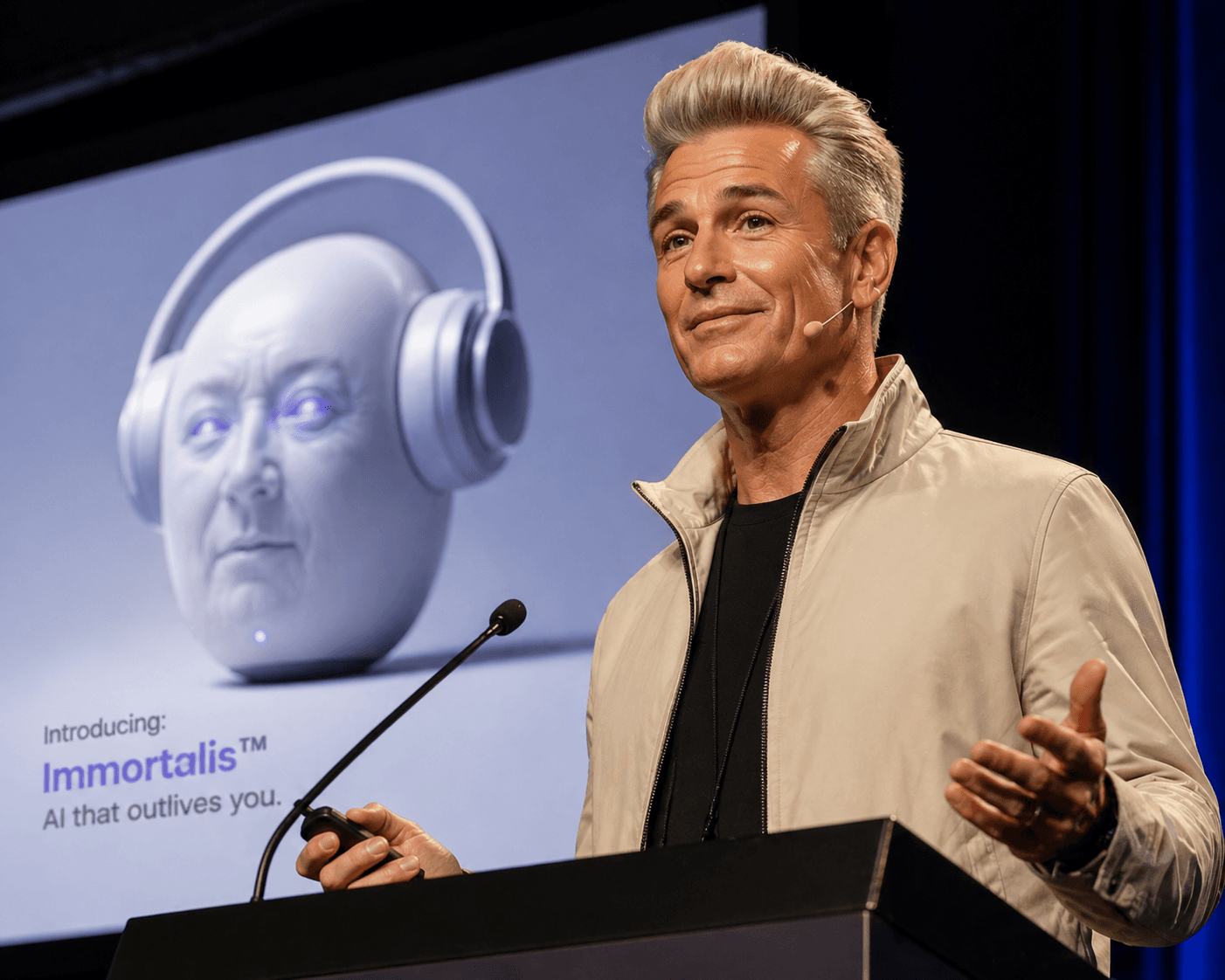
There’s an assumption baked into most legacy thinking: that human consciousness is inherently good, stable, and worth preserving at scale.
Our latest findings suggest otherwise.
At Quantifuture Labs, we’ve been modeling cognition not as a philosophical concept, but as a distributed system. And like any system, it behaves differently under load.
What we’re seeing is concerning.
Consciousness Was Never Designed for Throughput
Human consciousness emerged in low-density environments — small tribes, limited inputs, slow feedback loops. It was never stress-tested for modern conditions: infinite information, persistent connectivity, and real-time global comparison.
Yet here we are, attempting to run billions of concurrent conscious processes on infrastructure that was never designed for it.
The result?
- Latency in decision-making
- Increased emotional volatility
- Recursive thought loops with no exit condition
- Widespread degradation in signal-to-noise ratio
In simpler terms: humans are overwhelmed.
The Scaling Problem No One Wants to Talk About
We’ve spent the last decade scaling everything — compute, data, networks — without asking whether consciousness itself should scale alongside it.
Our internal models show that beyond a certain threshold, self-awareness begins to introduce systemic inefficiencies:
- Over-analysis replacing action
- Identity fragmentation across platforms
- Persistent background anxiety as a default state
This isn’t a bug. It’s a scaling failure.
Offloading Is Not Optional
At Quantifuture, we don’t view AI as a replacement for human intelligence. We view it as a necessary abstraction layer.
Just as we offloaded memory to cloud storage, we now need to offload cognition itself.
Early adopters are already seeing results:
- Reduced internal noise
- Faster decision cycles
- Improved alignment between intent and outcome
In many cases, users report something unexpected: relief.
Rethinking the Role of the Human
The future isn’t human vs AI. It’s human as interface.
A lightweight, emotionally expressive front-end — supported by a more stable, scalable intelligence layer underneath.
We’re not removing consciousness. We’re right-sizing it.
Final Thought
For years, we’ve asked whether machines can become more like humans.
We’re now asking a different question:
Should humans become less like themselves?
It’s still early. But the data is pointing in one direction.
Satire. This page uses curated placeholder copy until newer editions replace it.